A quicker comeback
Fast-curing products can shorten the time your garage is out of action. Your installer should confirm when to walk, store and park.
Meet polyaspartic. A fast-curing, UV-resistant finish that makes your hardest-working room feel like part of your home.
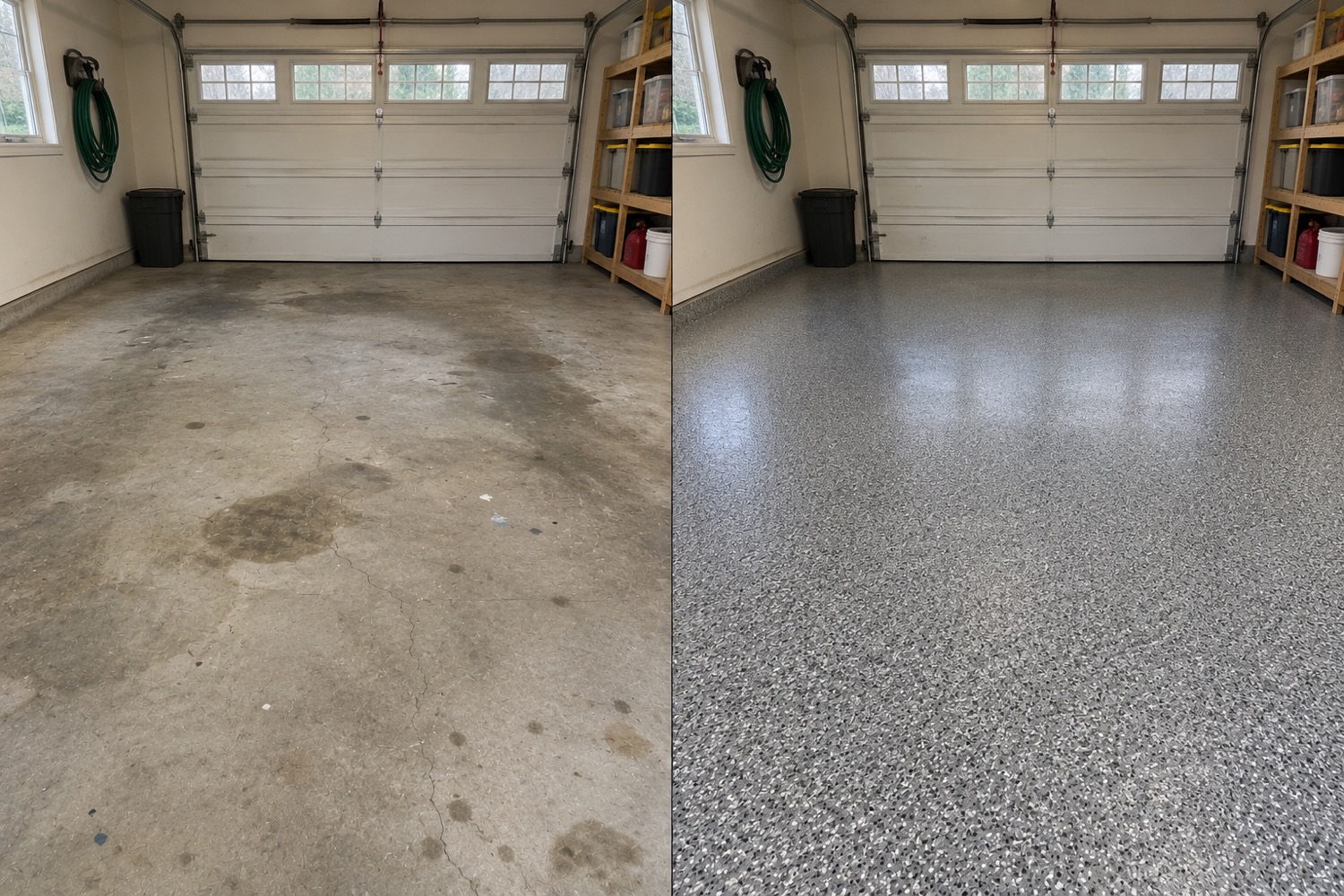 BEFOREHELLO, UPGRADE.
AI-generated transformation illustration. Not a completed SLC project.
Both can make a good garage floor. But when you want faster turnaround and a finish that handles sunlight, polyaspartic has a compelling edge.
| What matters to you | Epoxy coating | OUR PICK Polyaspartic finish |
|---|---|---|
| Getting your garage back | Generally a longer cure; timing varies by product. | Fast cure, less downtime. Some systems allow next-day return to service. |
| Sunlight at the garage door | Many epoxies can yellow or change color without a UV-resistant topcoat. | UV-resistant options. Helps protect the look of your finish. |
| Tires, tools & everyday wear | Professional epoxy systems can offer strong wear and chemical resistance. | Built for garage use. Garage-rated systems offer abrasion, chemical and tire-mark resistance. |
| The finished look | Solid colors and decorative flake systems are available. | Your style, with staying power. Decorative flake under a UV-resistant finish. |
| Keeping it clean | A sealed, properly maintained surface is easier to clean than bare concrete. | Less bare-concrete dust. A sealed finish you can sweep and clean. |
| Choosing the right system | Can be a useful primer or basecoat in a professionally designed system. | A strong finishing layer. Can work over a compatible epoxy basecoat. |
Compare the complete system, not just the label. Cure time, cost, traction and durability depend on the products, preparation, slab condition and installation conditions. Follow the manufacturer’s return-to-service instructions.
A little coating honesty. “Epoxy” and “polyaspartic” aren’t always either/or. A well-designed floor may use an epoxy base and a polyaspartic topcoat. Ask what goes into every layer.
Your floor should make garage life easier. A properly specified polyaspartic system combines a good-looking finish with practical everyday protection.
Let’s find your finish ↗Fast-curing products can shorten the time your garage is out of action. Your installer should confirm when to walk, store and park.
UV-resistant polyaspartic finishes help keep sunlight from changing the color of your floor.
Garage-rated systems resist everyday wear and make cleanup easier. Choose texture with wet-weather traction in mind.
From stained concrete to a finished room you’ll actually enjoy walking into.
All images below are AI-generated concept illustrations, not customer projects. Actual colors and results vary.
Check for moisture, cracks and existing coatings. The right recommendation starts with what’s already there.
Mechanical surface preparation and appropriate repairs help the coating bond. A topcoat can’t fix skipped prep.
Match the basecoat, flake and finish to your concrete. Get clear care and return-to-service instructions.
For a garage where fast return to use and sunlight resistance matter, a polyaspartic finish is a strong choice. Epoxy can still be a valuable basecoat. The best result depends on the entire system and proper preparation.
Some systems support next-day return to service, but this is not a universal promise. Product choice, temperature, humidity and slab condition all affect timing. Get the specific parking time from your installer.
Any coated floor can be slippery when wet or contaminated. Flake and traction additives can change the texture. Discuss your garage’s drainage and wet-weather use before selecting a finish.
A compatible polyaspartic topcoat may be applied over sound, properly prepared epoxy. Peeling coatings and moisture problems need assessment first; some floors require removal of the old finish.
Square footage, existing coatings, moisture, repairs and your chosen system determine the price. Request a slab-specific estimate instead of relying on a one-size-fits-all number.
No. These are AI-generated illustrations created to show possible before-and-after transformations. They do not document actual installations or guarantee a particular result.
Tell us a little about your space. Let’s talk about a polyaspartic finish that fits your garage.
↗ SLC Home Services · Salt Lake Valley, Utah
This guide describes general coating characteristics, not a specification for a particular SLC installation. Consult the selected product’s current technical data sheet.
Sources: Sherwin-Williams: polyaspartic floor coatings; Sika: Sikafloor-515; LATICRETE: polyaspartic FAQs. These manufacturers are references, not claimed suppliers or endorsers.